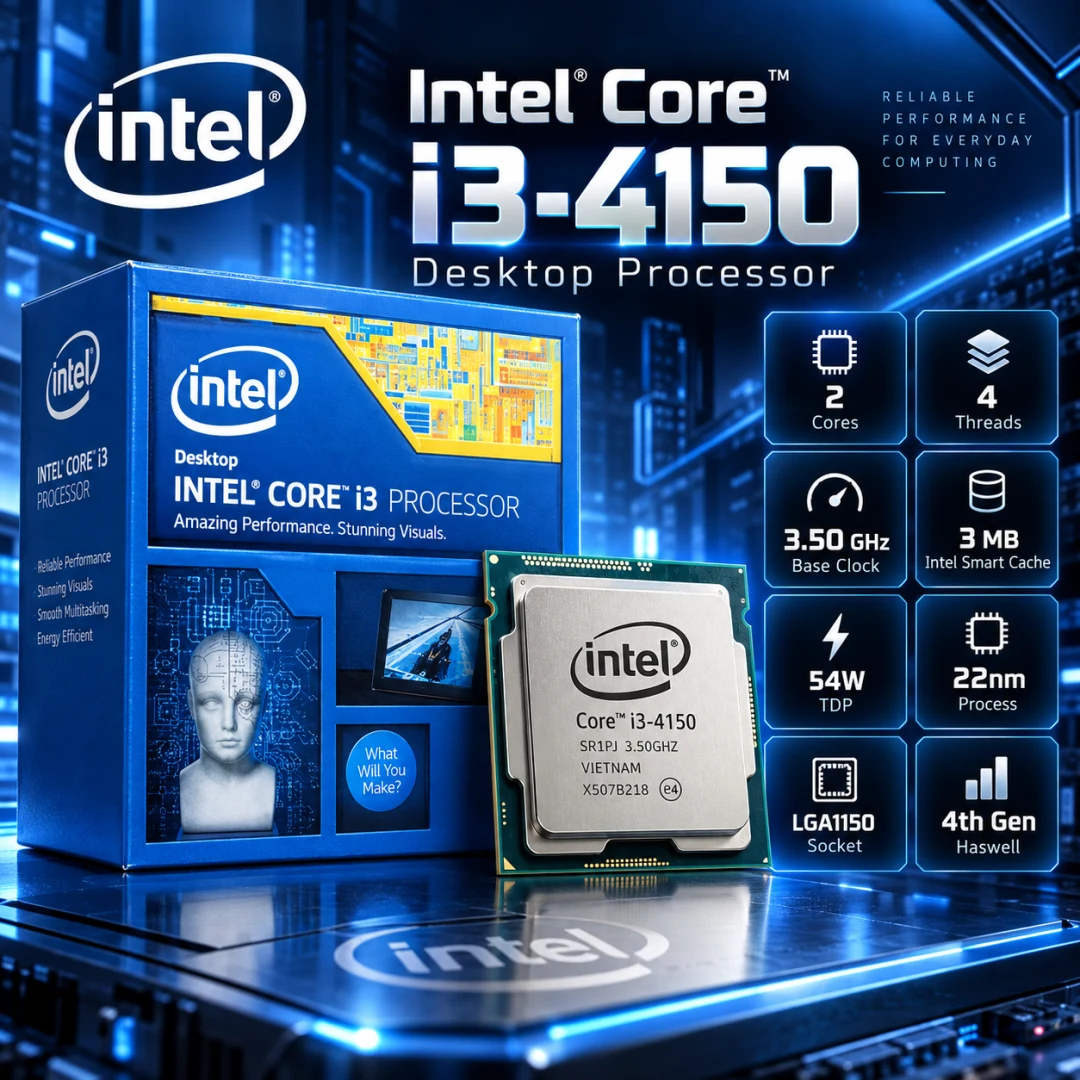
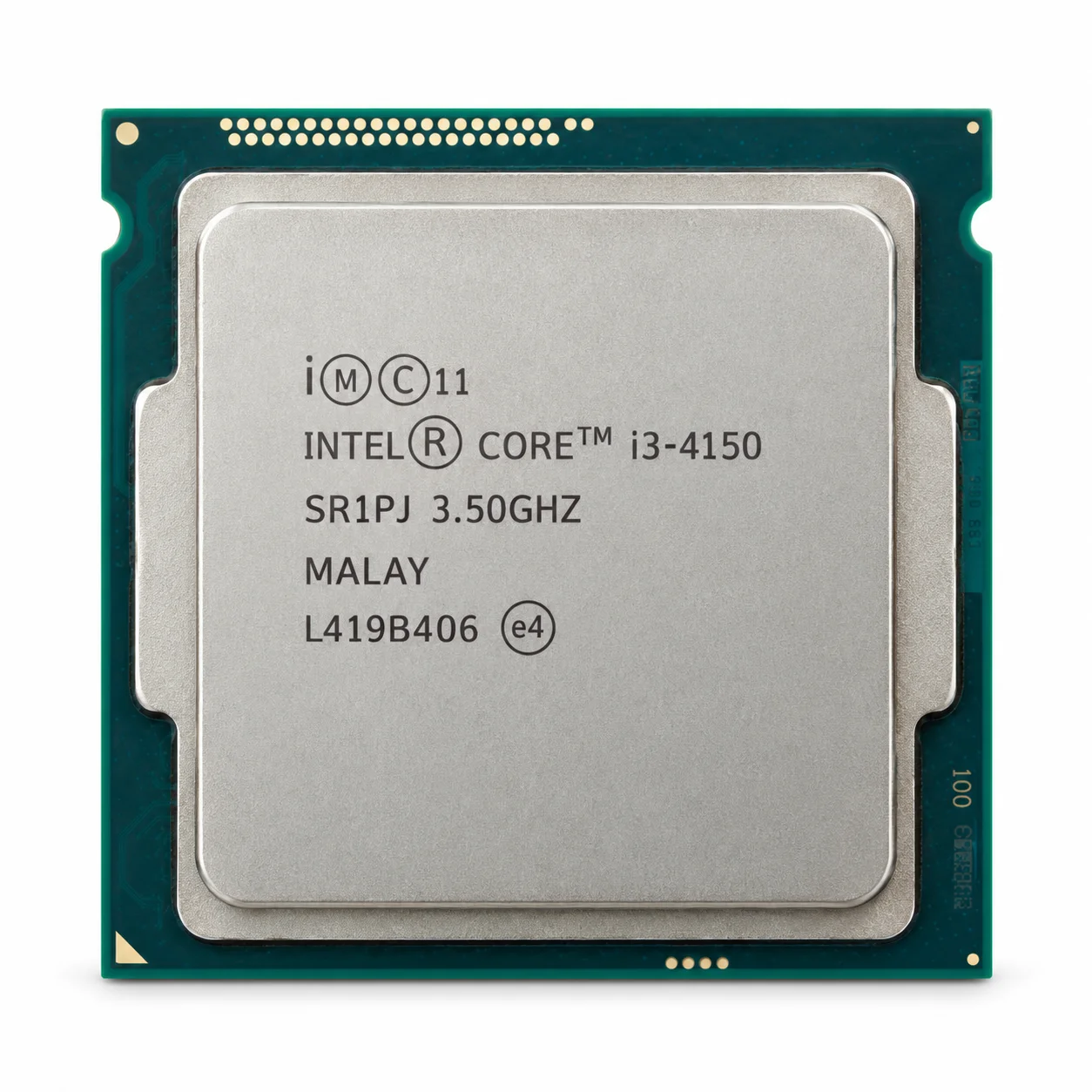
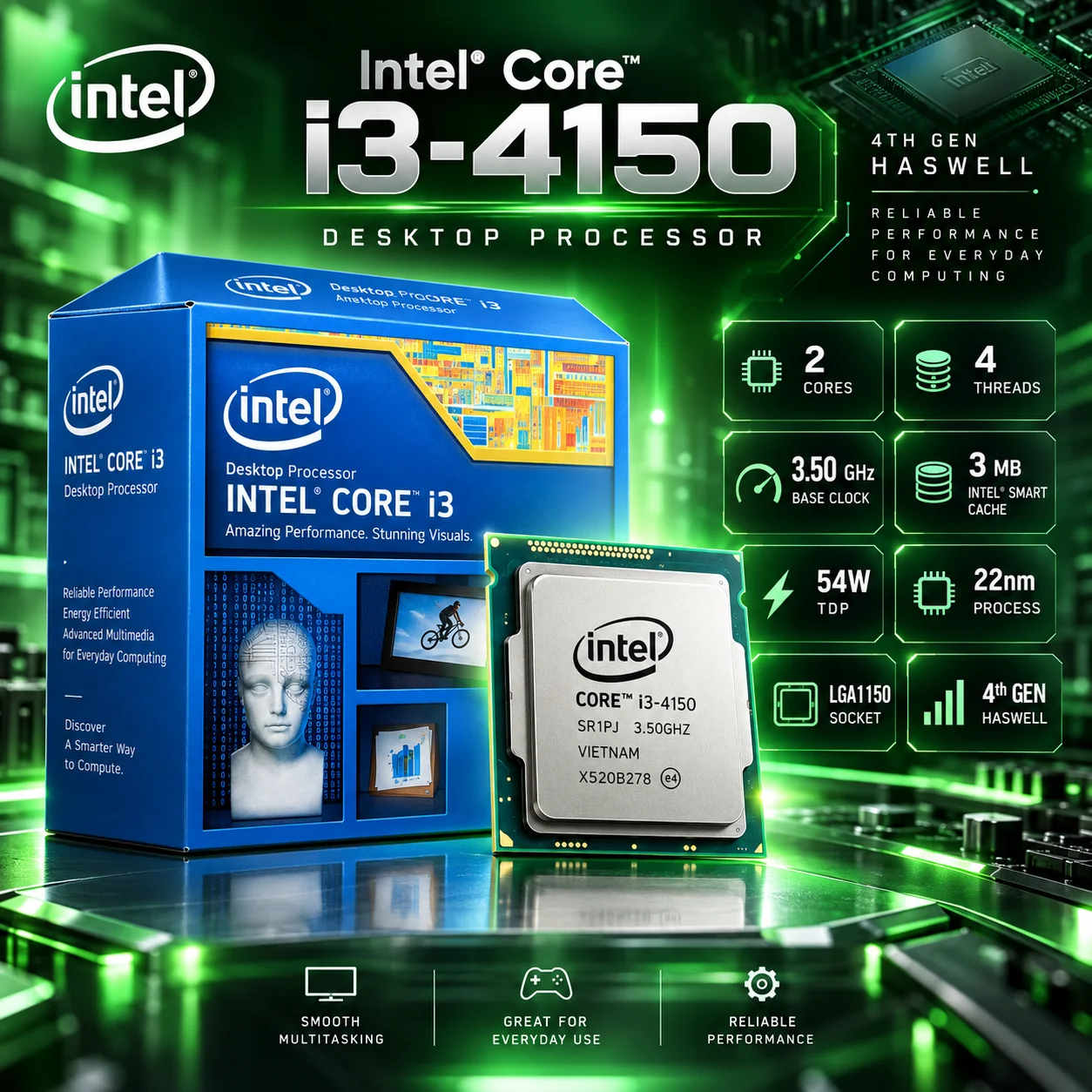
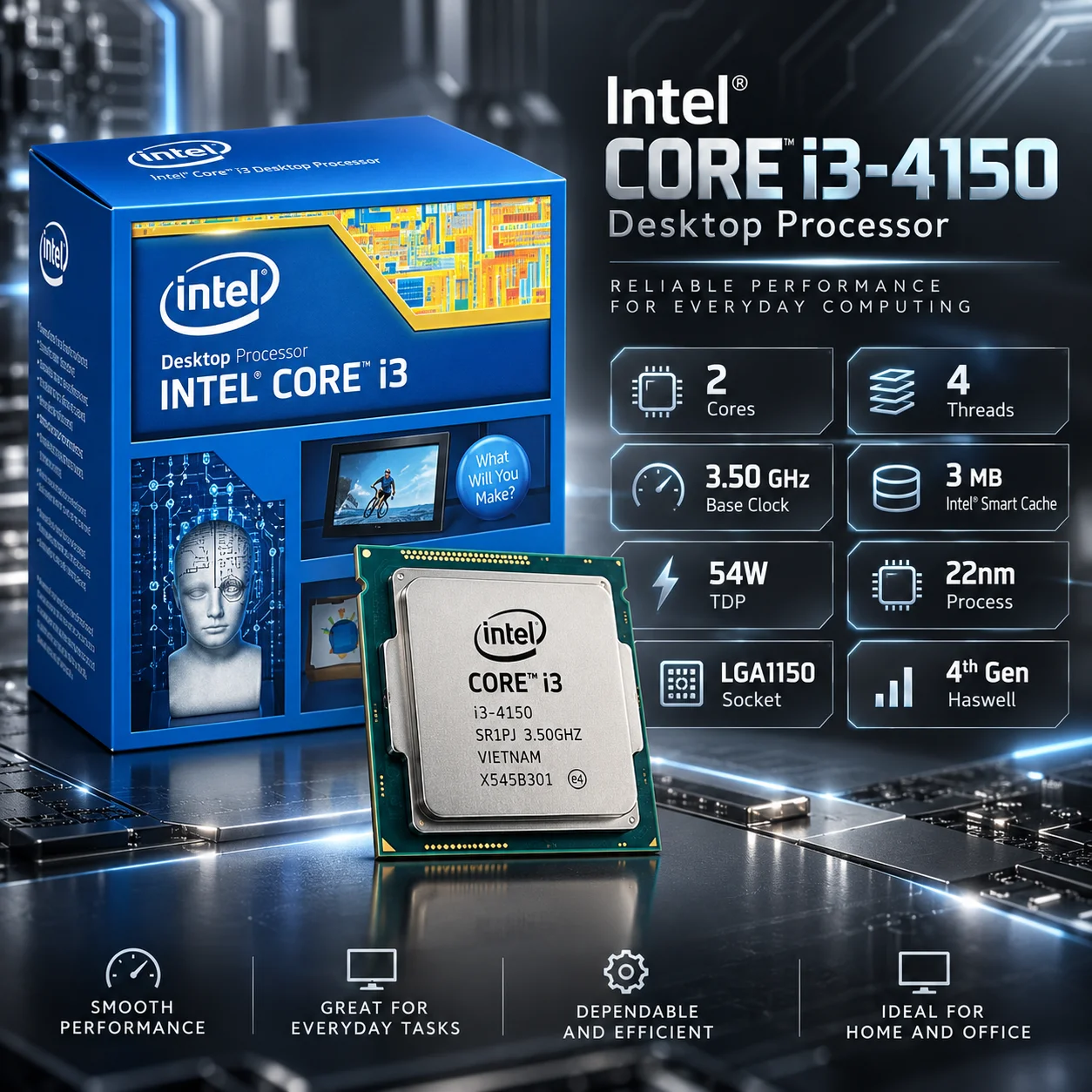
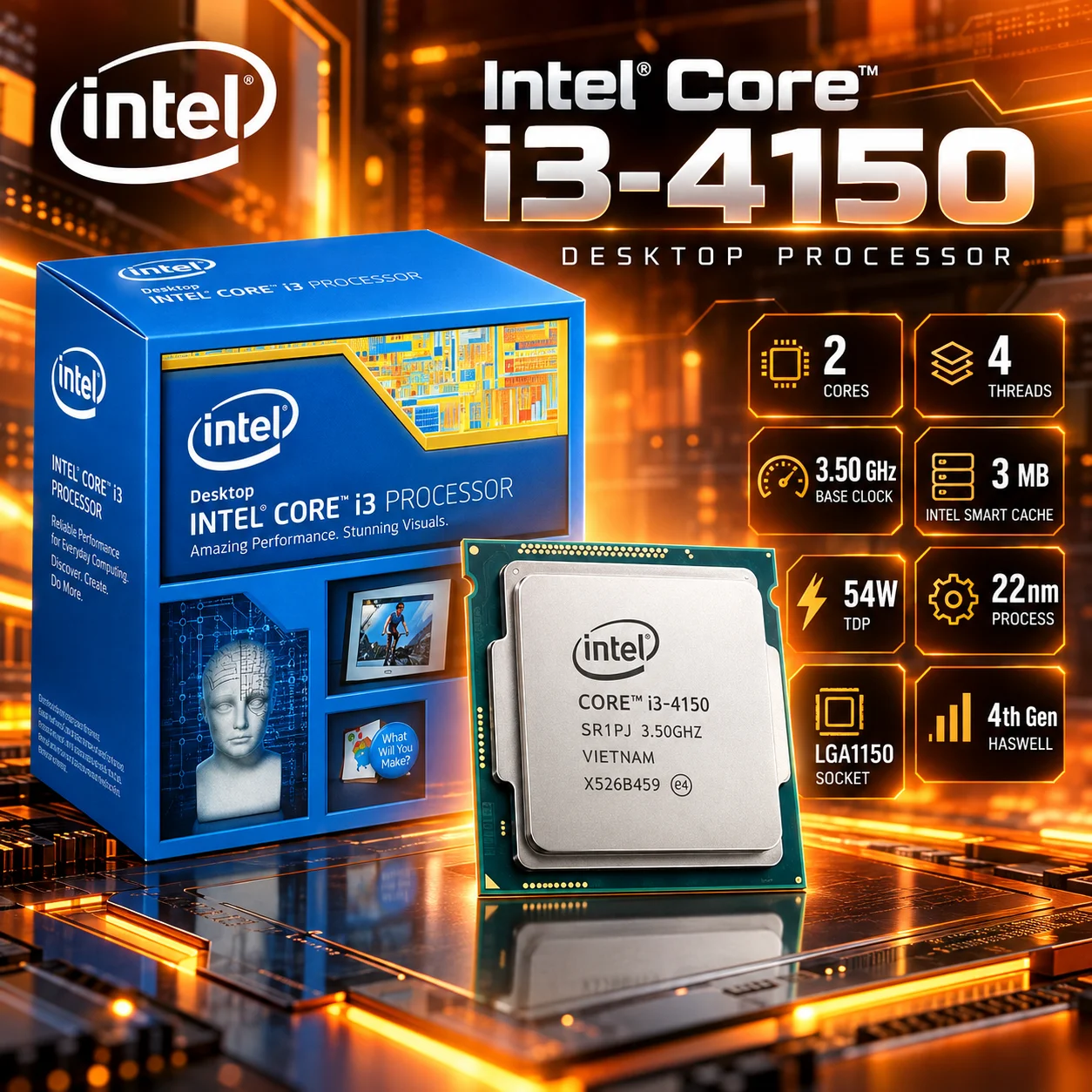
Intel Core i3-4150 2-Core, 4-Thread Desktop Processor
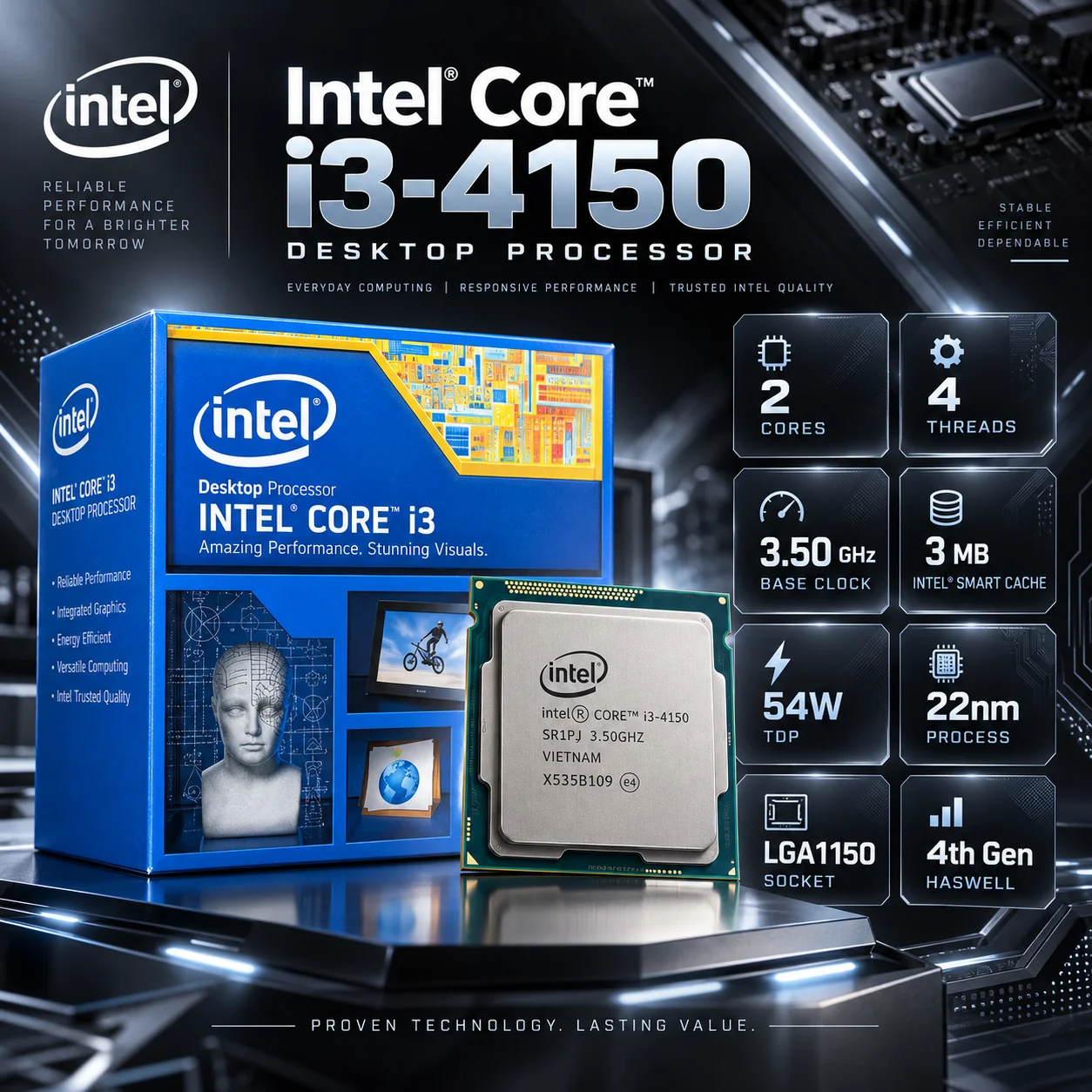
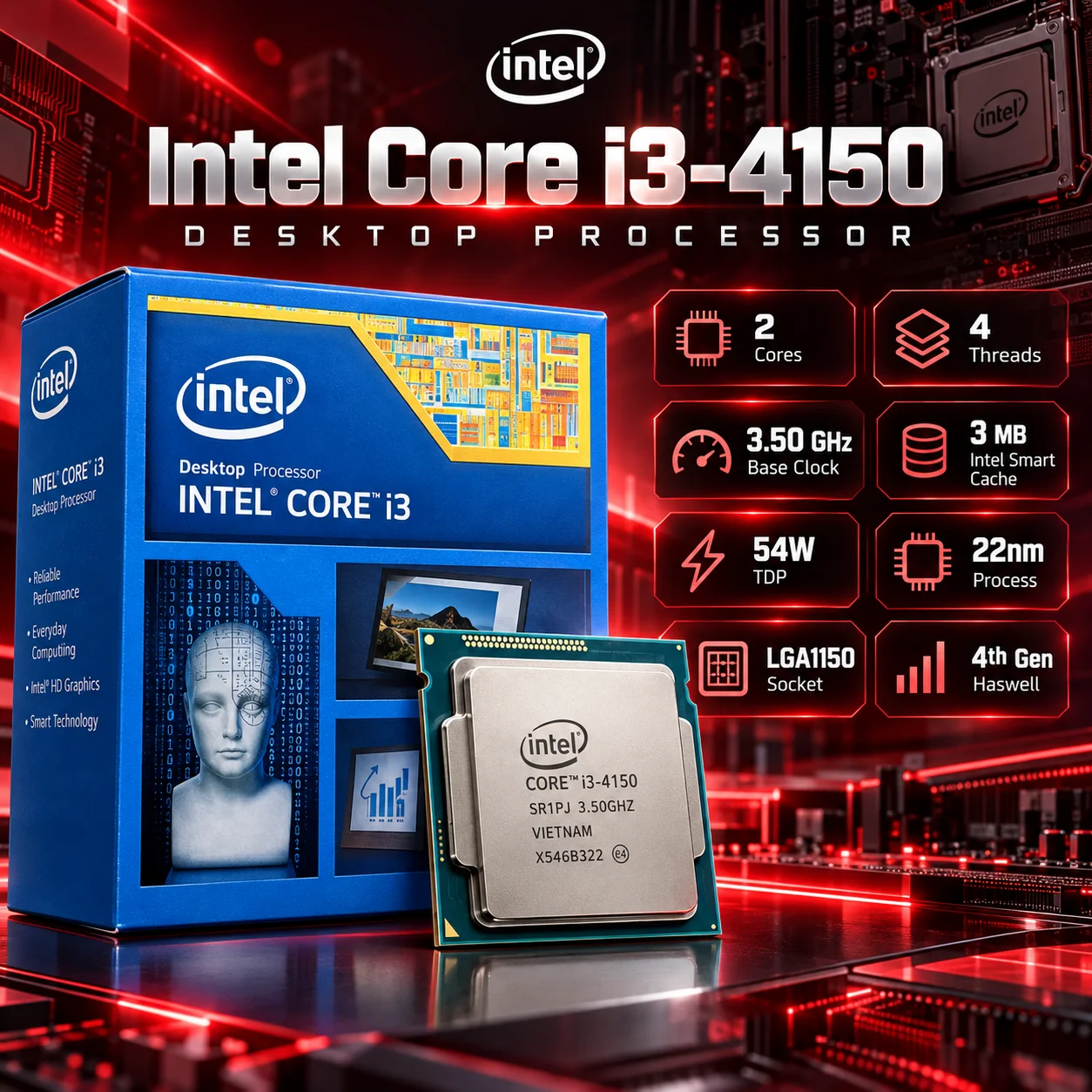
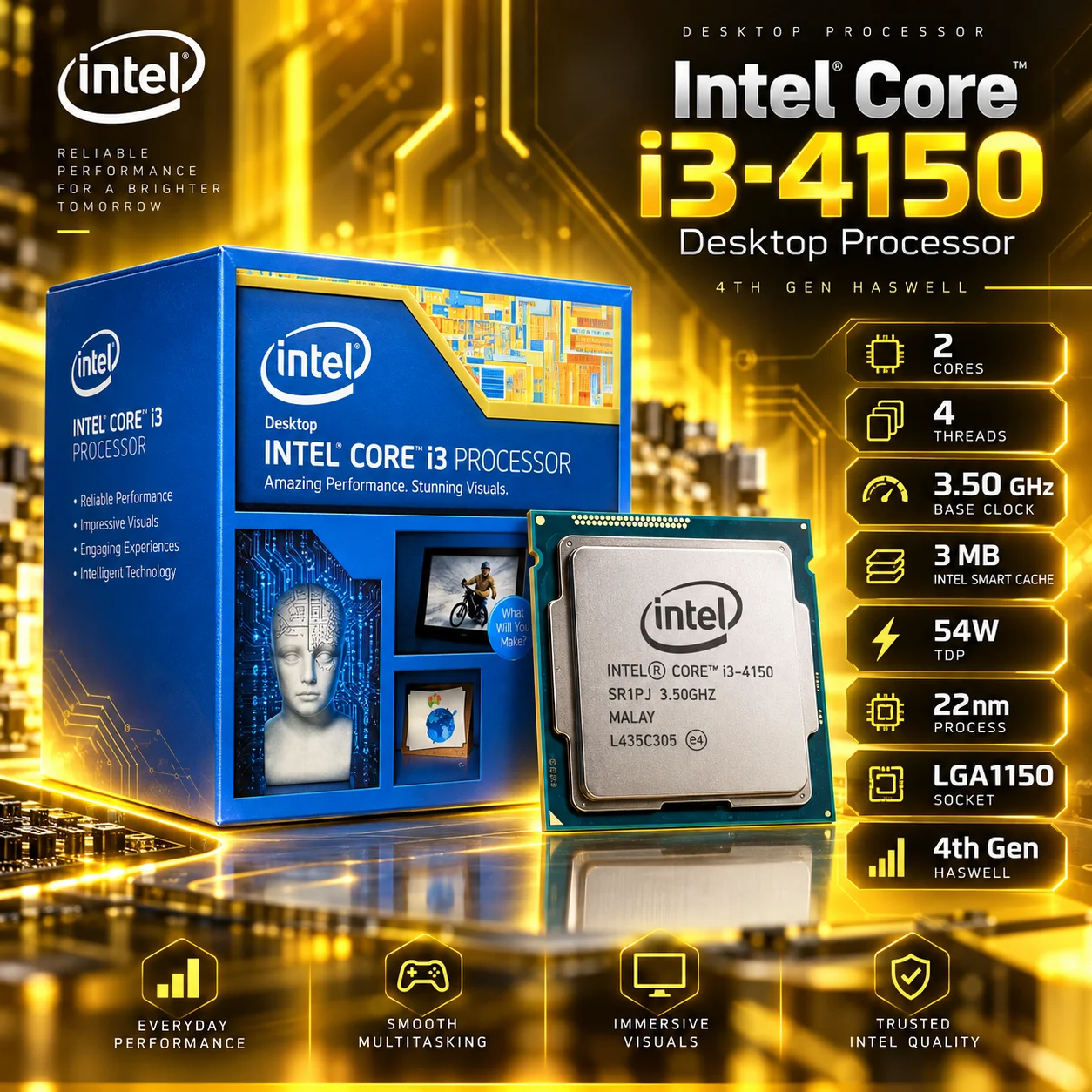
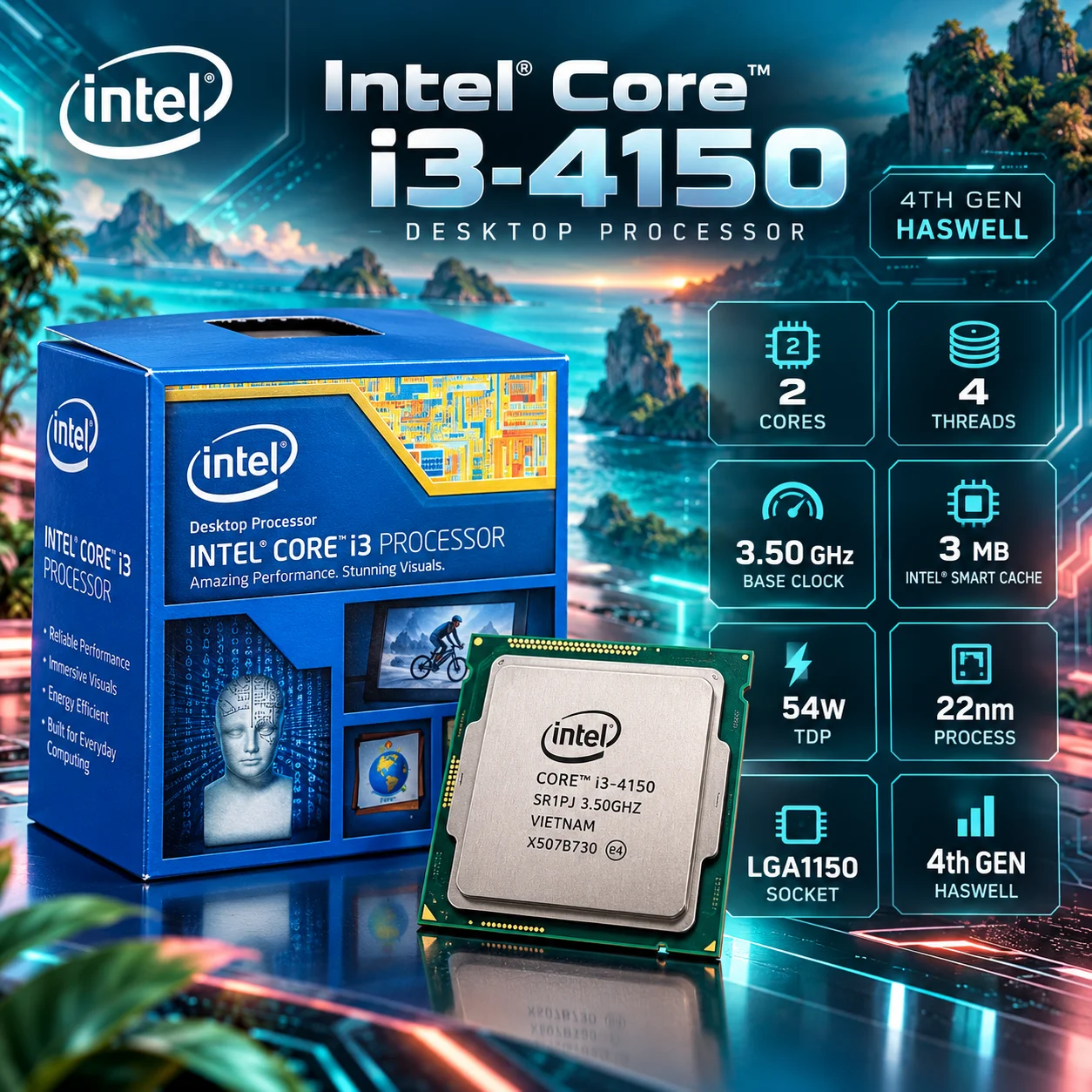
- 2 cores and 4 threads with Intel Hyper-Threading Technology
- 3.50 GHz base frequency with 3 MB L3 cache
- Intel HD Graphics 4400 integrated graphics support
- Supports DDR3-1333/1600 memory up to 32 GB
*Approximate regional retail guide prices. Pixahunt is an informational catalog.
CPU Benchmark Scores & Performance Analysis
TESTEDCinebench R23, Geekbench 6, PassMark CPU Mark scores & real-world gaming/office suitability tests.
Technical Specifications
Comprehensive hardware architecture and specifications
General
| Series |
Core i3
Selected Variant
|
| Model |
i3-4150
Selected Variant
|
| Cpu Cooler |
Not Included
Selected Variant
|
| Code-Name |
Haswell
Selected Variant
|
| Generation |
4th Gen
Selected Variant
|
| Sockets Supported |
FCLGA1150
Selected Variant
|
| Release Date |
May 11, 2014
Selected Variant
|
Performance
| Base Frequency |
3.50 GHz
Selected Variant
|
| Turbo Frequency Max. |
N/A
Selected Variant
|
| Core |
2
Selected Variant
|
| Threads |
4
Selected Variant
|
| CPU Cache |
3 MB Intel Smart Cache
Selected Variant
|
| L1 Cache |
64 KB (per core)
Selected Variant
|
| L2 Cache |
256 KB (per core)
Selected Variant
|
| L3 Cache |
3 MB
Selected Variant
|
| TDP |
54 W
Selected Variant
|
| Lithography |
22 nm
Selected Variant
|
| Multiplier |
35.0x
Selected Variant
|
| Multiplier Unlocked |
No
Selected Variant
|
| Processor Type. |
Desktop Processor (2 Cores, 4 Threads)
Best for: Everyday Office Multitasking, Fast Browsing & Entry-Level 720p/1080p Gaming Selected Variant |
Memory Support
| Memory Max. |
32 GB
Selected Variant
|
| Memory Type |
DDR3-1333/1600, DDR3L-1333/1600
Selected Variant
|
| Memory Speed |
1600 MT/s
Selected Variant
|
| Memory Channel |
2
Selected Variant
|
| Max Memory Bandwidth |
25.6 GB/s
Selected Variant
|
| ECC Memory Supported |
Yes
Selected Variant
|
Graphics
| Built-in GPU |
Yes
Selected Variant
|
| Processor Graphics |
Intel HD Graphics 4400
Selected Variant
|
| Graphics Base Frequency |
350 MHz
Selected Variant
|
| Graphics Dynamic Frequency |
1.15 GHz
Selected Variant
|
| Graphics Core Count |
N/A
Selected Variant
|
| Max Video Memory |
2 GB
Selected Variant
|
| Max Resolution |
HDMI: 4096x2304 @24Hz, DP: 3840x2160 @60Hz, VGA: 1920x1200 @60Hz
Selected Variant
|
Technical Info
| DirectX Support |
11.1/12
Selected Variant
|
| OpenGL Support |
4.3
Selected Variant
|
| Approx. Power Consumption |
54 W
Selected Variant
|
| Compatible Products / Chipsets |
Intel 8 Series, Intel 9 Series
Selected Variant
|
| PCI Express Version |
Up to 3.0
Selected Variant
|
| PCI Express Lanes |
Up to 1x16, 2x8, 1x8+2x4 (16 Max)
Selected Variant
|
| Thermal Solution (MPK / Box) |
PCG 2013C
Selected Variant
|
| Max. Operating Temperature (Tjmax) |
72°C
Selected Variant
|
Warranty
| ManufacturingWarranty |
3 Years Limited
Selected Variant
|
Additional Info
| Specialty |
Intel Hyper-Threading Technology, Intel Virtualization Technology (VT-x), Intel AES New Instructions
Selected Variant
|
| Others |
Instruction Set Extensions: Intel SSE4.1, Intel SSE4.2, Intel AVX2
Selected Variant
|
| Country Of Origin |
USA
Selected Variant
|
| Made in/ Assemble |
China / Malaysia
Selected Variant
|
Editorial Overview & Review
In-depth insights, architecture summary, and performance evaluation
Introduction & Overview: The Reliable Workhorse for Budget Builders
When diving into the desktop processor market, finding that sweet spot between cost-efficiency and daily performance is always the primary quest for budget-conscious builders and office system integrators. Enter the Intel Core i3-4150, a quintessential member of Intel's legendary 4th Generation "Haswell" family built on a refined 22nm lithography.
Positioned squarely in the entry-to-mid-range tier, the i3-4150 is designed for mainstream users, students, light professionals, and casual gamers who need dependable, snappy computing without breaking the bank. It strips away enthusiast-grade complexities like overclocking and extreme core counts, focusing instead on delivering robust, everyday computing performance on the widely accessible FCLGA1150 socket platform (compatible with Intel 8 and 9 series chipsets).
Architecture, Performance & Key Technologies: Under the Hood of Haswell
At its core, the Intel Core i3-4150 relies on a dual-core architecture paired with Intel Hyper-Threading Technology, effectively presenting four threads to the operating system. This dual-core/four-thread setup allows the processor to effortlessly juggle multiple background tasks, significantly improving multitasking responsiveness compared to older or lower-tier dual-core chips.
- Clock Speed: Operates at a solid, unyielding base frequency of 3.50 GHz (with a 35.0x multiplier, though strictly locked against overclocking).
- Cache: Equipped with 3 MB of Intel Smart Cache (L3) alongside 256 KB of L2 cache and 64 KB of L1 cache per core.
- Power Efficiency: Boasts a modest Thermal Design Power (TDP) of just 54 W, making it exceptionally easy to cool and cheap to run.
- Integrated Graphics: Features onboard Intel HD Graphics 4400, base-clocked at 350 MHz and scaling dynamically up to 1.15 GHz, capable of driving high-resolution displays (up to 4K at 24Hz via HDMI or 4K at 60Hz via DisplayPort).
- Memory Support: Dual-channel memory controller supporting up to 32 GB of DDR3-1333/1600 or DDR3L memory, delivering a maximum memory bandwidth of 25.6 GB/s, with the added enterprise-friendly bonus of ECC memory support.
The Haswell microarchitecture brings vital instruction set extensions to the table, including Intel AVX2 for enhanced floating-point vector calculations, along with AES-NI for accelerated data encryption. Paired with up to 16 lanes of PCI Express 3.0, the platform ensures your discrete graphics cards and storage drives communicate at blistering speeds.
Real-World Use Cases: Where Does the i3-4150 Shine?
So, how does these specifications translate to your daily workflow? In real-world scenarios, the 3.50 GHz clock speed is a massive asset. Because many everyday applications rely heavily on single-thread or dual-thread performance rather than utilizing ten-plus cores, the i3-4150 feels remarkably snappy when launching applications, browsing the web with dozens of tabs open, or handling heavy Microsoft Office suites.
For home offices and student environments, this processor handles word processing, spreadsheet crunching, Zoom calls, and media streaming with absolute ease. Thanks to the Intel HD Graphics 4400, users can build a capable HTPC (Home Theater PC) without immediately needing a dedicated graphics card, enjoying smooth 1080p and 4K media playback.
When it comes to gaming, the i3-4150 punches above its weight class when paired with a modest entry-level discrete GPU (such as an NVIDIA GTX 1050 or similar). Esports titles like Counter-Strike, League of Legends, and Dota 2 run smoothly at respectable settings. While modern AAA blockbusters will push the dual-core design to its limits, older titles and casual gaming setups are handled without breaking a sweat.
Strengths & Potential Considerations
Every hardware component comes with its unique set of trade-offs. Here is how the Intel Core i3-4150 stacks up:
- Strengths (Pros):
- Strong single-thread 3.50 GHz performance ensures snappy day-to-day responsiveness.
- Hyper-Threading (4 threads) provides a noticeable multitasking boost over basic dual-cores.
- Low 54W power consumption results in minimal heat and quiet cooling operations.
- Includes capable integrated graphics with multi-display and 4K support.
- Support for ECC memory adds versatility for niche server or workstation builds.
- Considerations (Cons):
- Strictly locked multiplier means zero headroom for overclocking enthusiasts.
- Only 2 physical cores can bottleneck modern, heavily multithreaded productivity software or AAA gaming titles.
- Relies on an older generation DDR3 memory standard.
- No Turbo Boost technology—the processor permanently locks at 3.50 GHz.
Final Buying Verdict: Is It Worth the Investment?
As a technology reviewer, evaluating legacy and budget-tier hardware requires looking at the big picture. The Intel Core i3-4150 is a testament to Intel's engineering stability during the Haswell era. It doesn't attempt to cater to high-end content creators or hardcore 4K gamers. Instead, it carved out a reputation as a dependable, bulletproof solution for foundational computing.
Who should buy this? If you are assembling an affordable office desktop, a dependable family PC, a student workstation, or an entry-level media center on a strict budget—and you already have access to an LGA1150 motherboard—the i3-4150 remains a remarkably capable and cost-effective chip. While modern computing has marched forward into higher core counts, the i3-4150 proudly holds its ground as a budget titan of efficient, everyday performance.
OUR RATING CONSENSUS
The overall rating is based on review by our experts & industry benchmark suites
Quick Snapshot
- Overall Rating
- 4.8 / 10
- Brand
- Intel
- Category
- Processor
- Catalog Model
- i3-4150
- Status
- Published
- Release Date
- May 11, 2014
Pixahunt Tech Community
Connect with hardware enthusiasts, compare benchmarks, and explore real user setups.
Explore Full Newsfeed →Related Gadgets
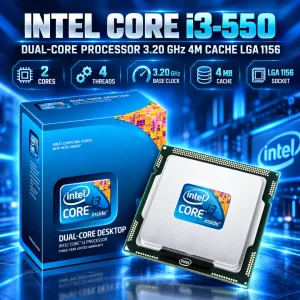
- 3.20 GHz Dual-Core Clock Speed for Reliable Everyday Computing
- Intel Hyper-Threading Technology Enabling 4 Parallel Threads
- Built-in Intel HD Graphics for Integrated Display Support
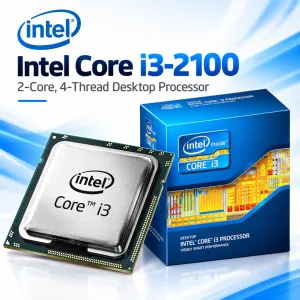
- 2 cores and 4 threads with Intel Hyper-Threading Technology
- 3.10 GHz base processor frequency
- 3 MB Intel Smart Cache
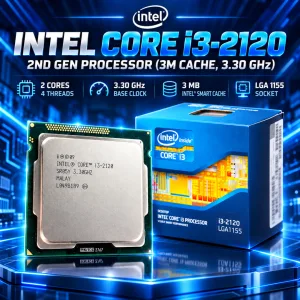
- 2 Cores and 4 Threads with Intel Hyper-Threading Technology
- 3.30 GHz Base Clock Frequency with 3 MB Intel Smart Cache
- Includes Intel HD Graphics 2000 integrated graphics
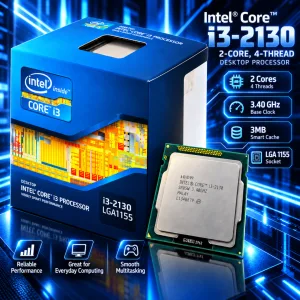
- 2 cores and 4 threads with Intel Hyper-Threading Technology
- 3.40 GHz processor base frequency with 3 MB Intel Smart Cache
- Integrated Intel HD Graphics 2000
Compare i3-4150 with Similar Processor
Real-world benchmark differences, TDP energy consumption, pros & cons, and market pricing in Bangladesh.