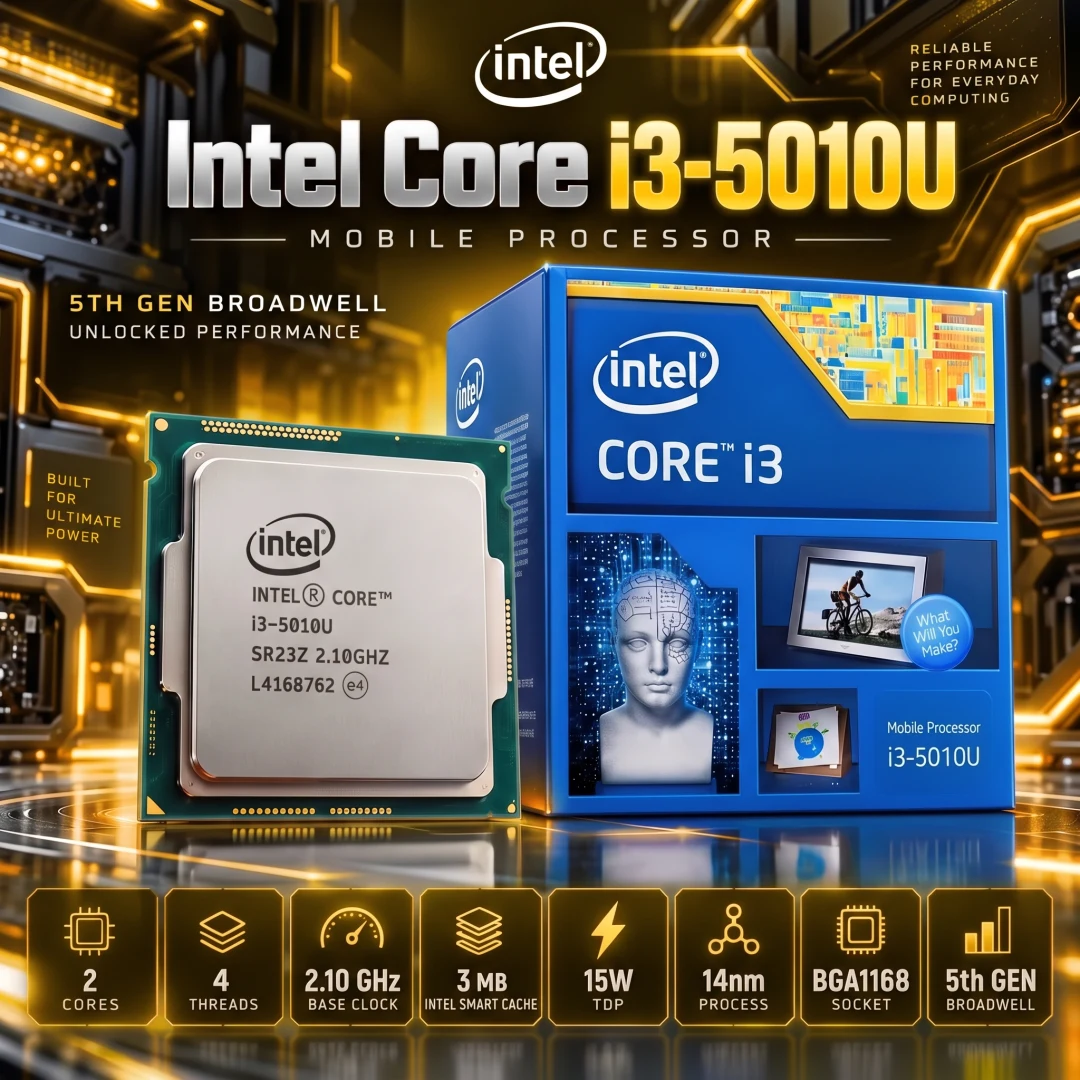
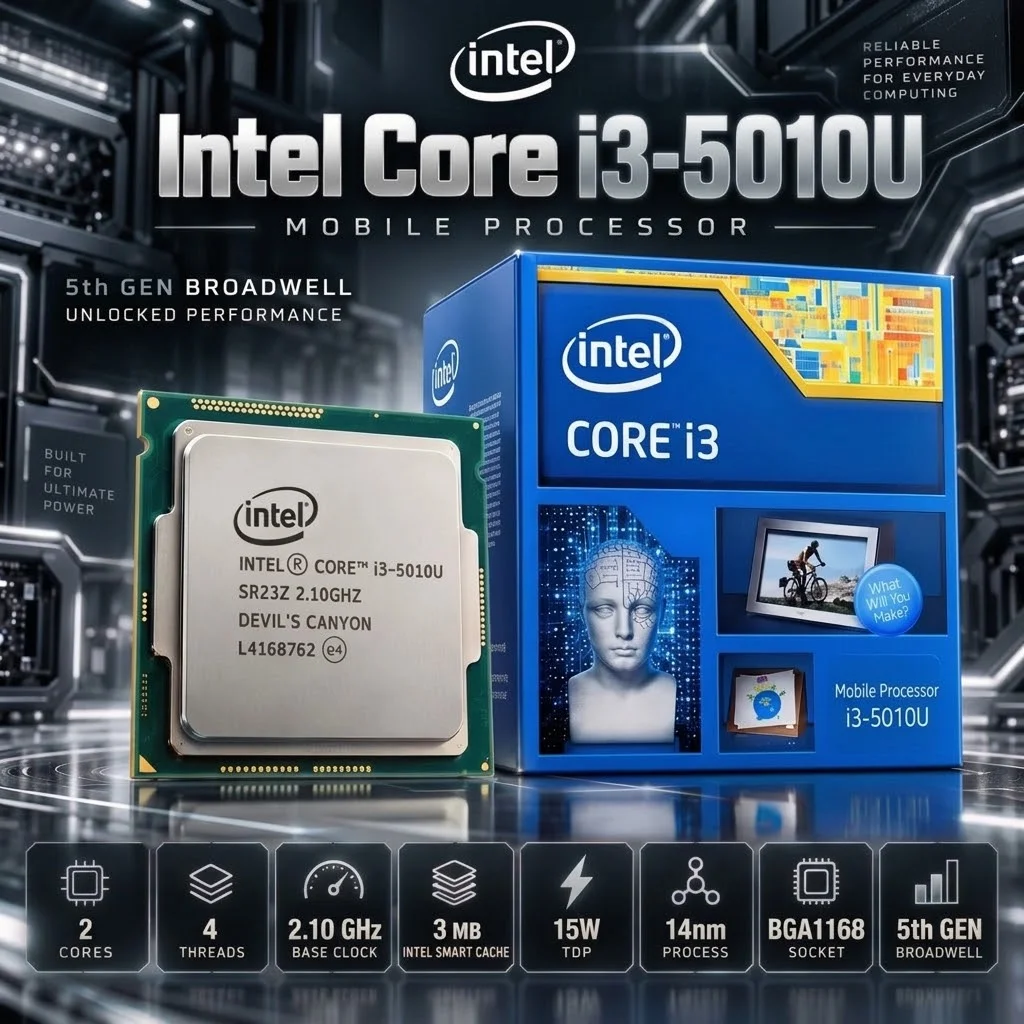
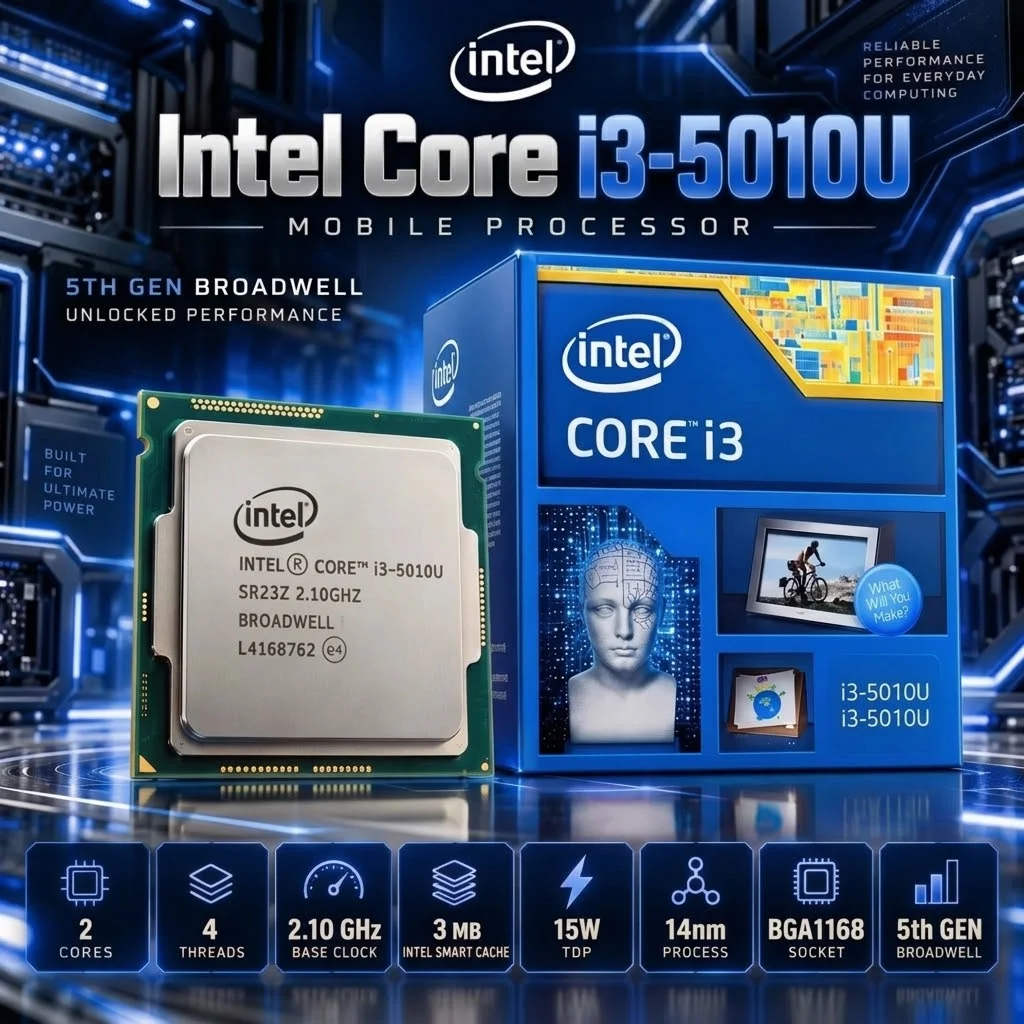
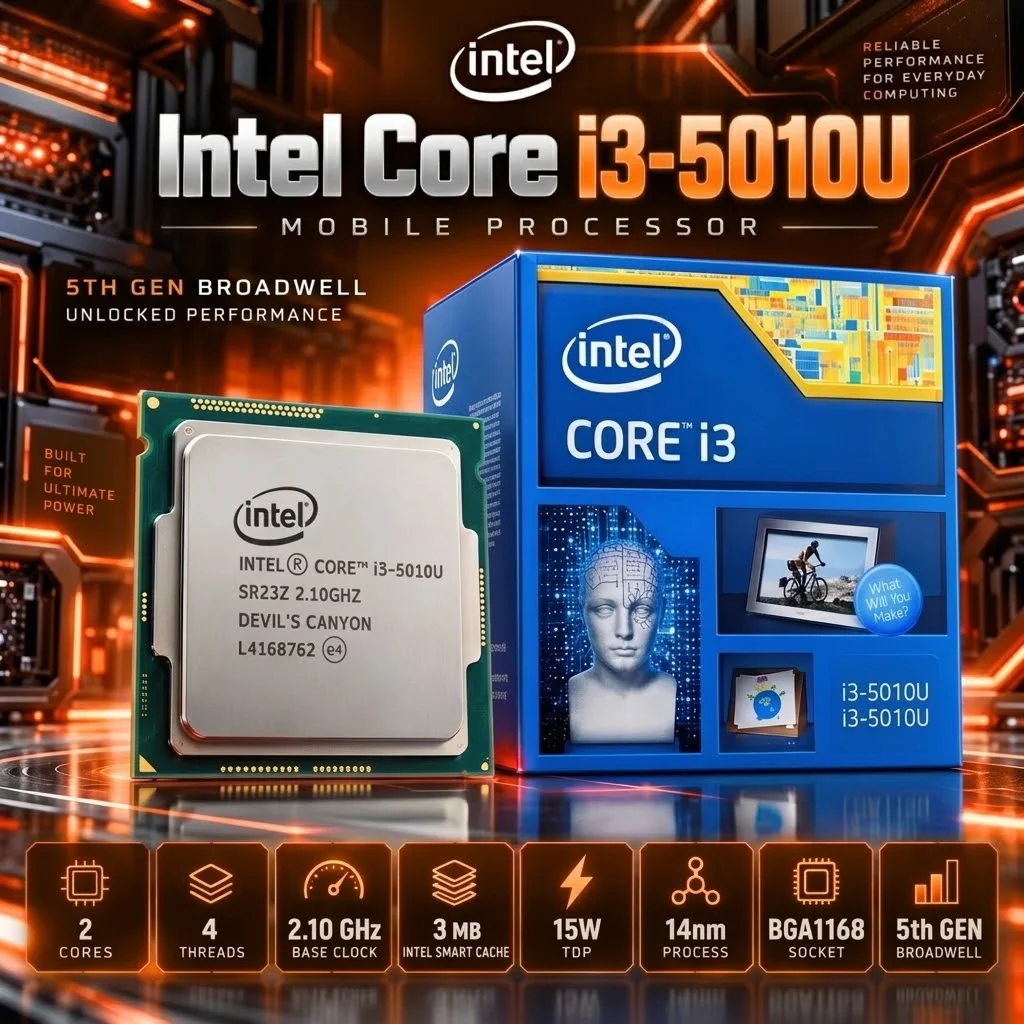
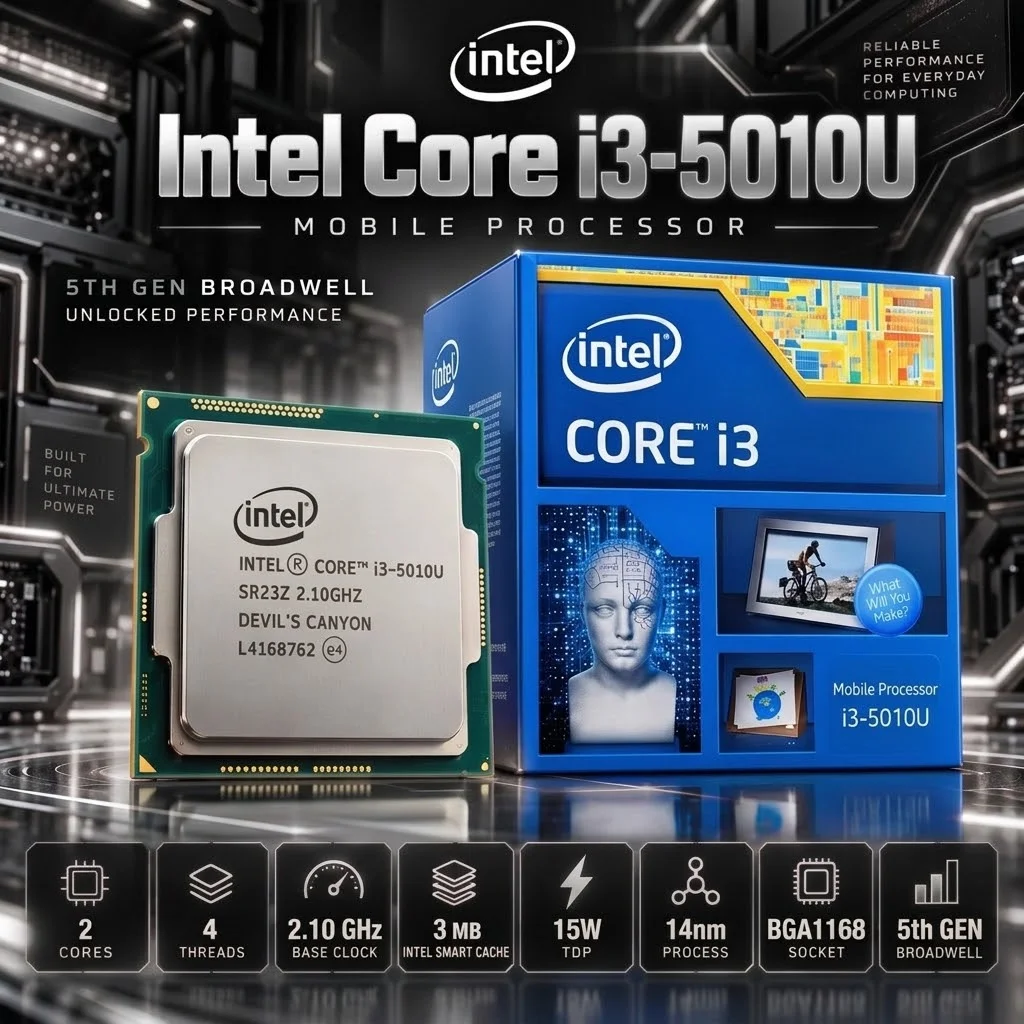
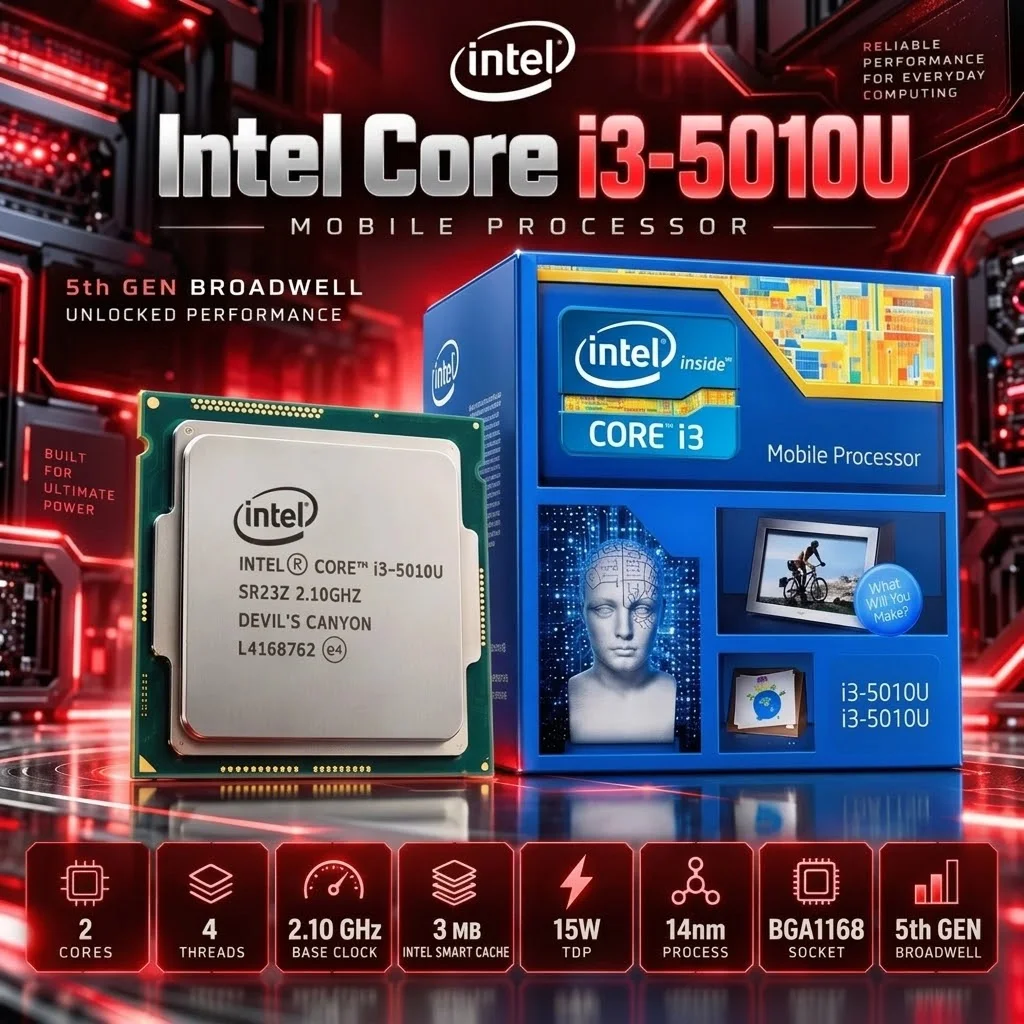
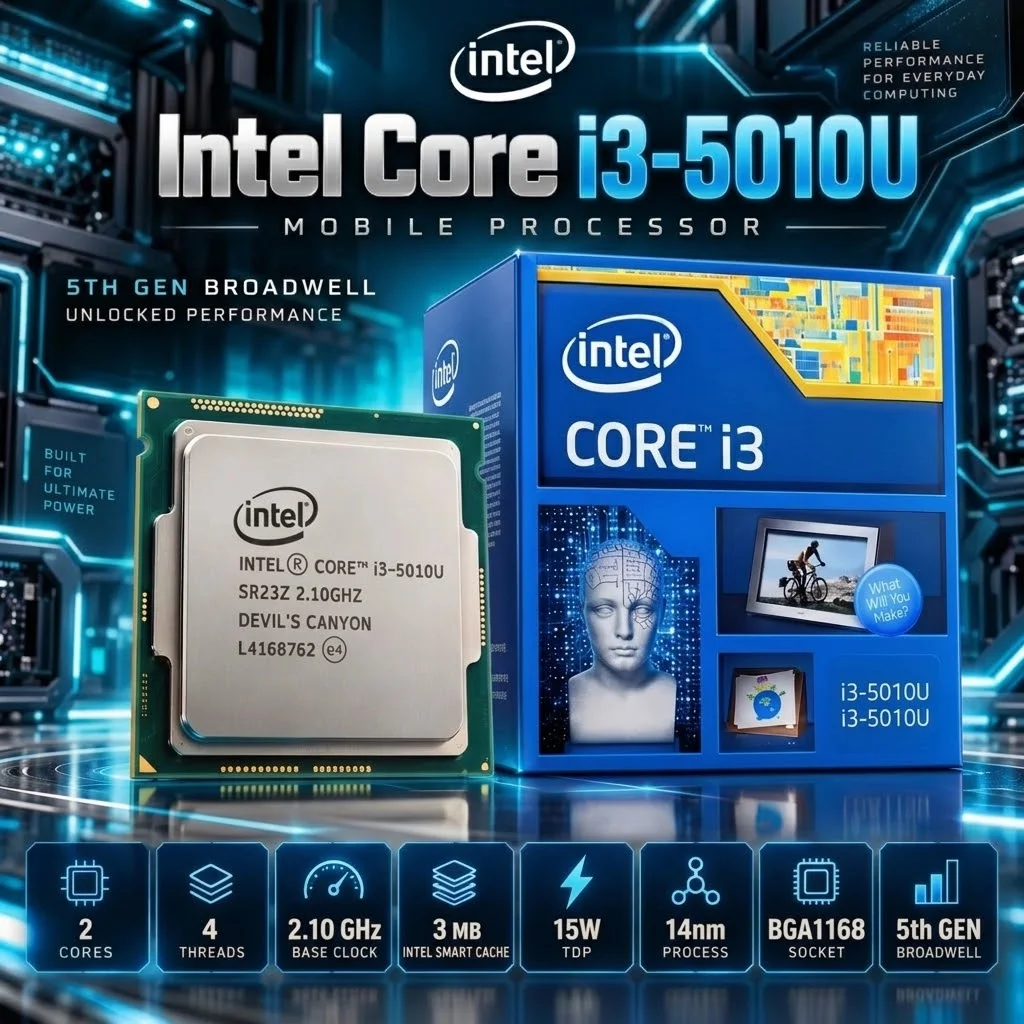
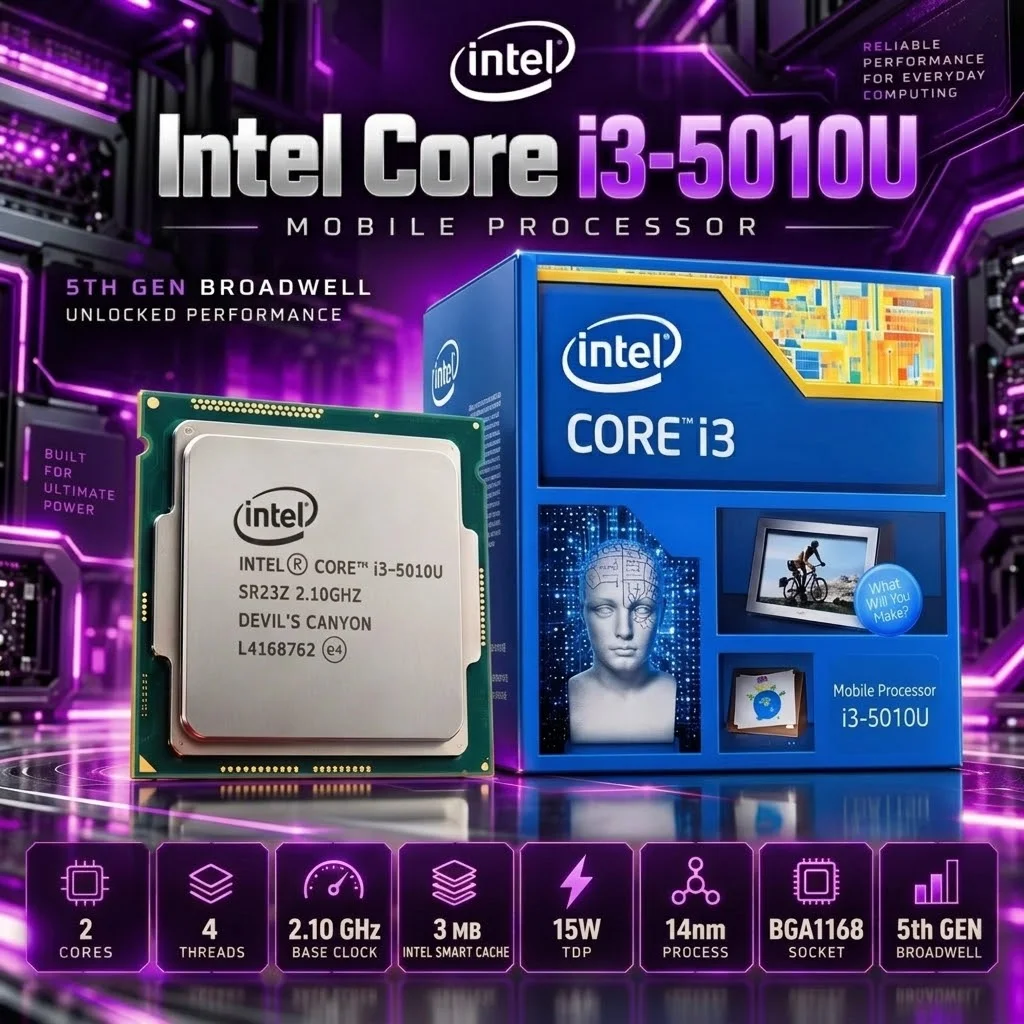
Intel Core i3-5010U Mobile Processor (3M Cache, 2.10 GHz)
- 2 cores and 4 threads with Intel Hyper-Threading Technology
- 2.10 GHz base frequency with 3 MB L3 cache
- Integrated Intel HD Graphics 5500
- 15W TDP optimized for power efficiency in thin laptops
*Approximate regional retail guide prices. Pixahunt is an informational catalog.
CPU Benchmark Scores & Performance Analysis
TESTEDCinebench R23, Geekbench 6, PassMark CPU Mark scores & real-world gaming/office suitability tests.
Technical Specifications
Comprehensive hardware architecture and specifications
General
| Series |
Core i3
Selected Variant
|
| Model |
i3-5010U
Selected Variant
|
| Cpu Cooler |
Not Included
Selected Variant
|
| Code-Name |
Broadwell
Selected Variant
|
| Generation |
5th Gen
Selected Variant
|
| Sockets Supported |
FCBGA1168
Selected Variant
|
| Release Date |
January 5, 2015
Selected Variant
|
Performance
| Processor Type. |
Laptop / Notebook Mobile Processor (2 Cores, 4 Threads)
Best for: Thin & Light Everyday Laptops, Office Documents & Smooth HD Streaming Selected Variant |
| Base Frequency |
2.10 GHz
Selected Variant
|
| Turbo Frequency Max. |
N/A
Selected Variant
|
| Core |
2
Selected Variant
|
| Threads |
4
Selected Variant
|
| CPU Cache |
3 MB L3 Cache
Selected Variant
|
| L1 Cache |
128 KB
Selected Variant
|
| L2 Cache |
512 KB
Selected Variant
|
| L3 Cache |
3 MB
Selected Variant
|
| TDP |
15 W
Selected Variant
|
| Lithography |
14 nm
Selected Variant
|
| Multiplier |
21.0x
Selected Variant
|
| Multiplier Unlocked |
No
Selected Variant
|
Memory Support
| Memory Max. |
16 GB
Selected Variant
|
| Memory Type |
DDR3L 1333/1600, LPDDR3 1333/1600
Selected Variant
|
| Memory Speed |
Up to 1600 MT/s
Selected Variant
|
| Memory Channel |
2
Selected Variant
|
| Max Memory Bandwidth |
25.6 GB/s
Selected Variant
|
| ECC Memory Supported |
No
Selected Variant
|
Graphics
| Built-in GPU |
Yes
Selected Variant
|
| Processor Graphics |
Intel HD Graphics 5500
Selected Variant
|
| Graphics Base Frequency |
300 MHz
Selected Variant
|
| Graphics Dynamic Frequency |
900 MHz
Selected Variant
|
| Graphics Core Count |
N/A
Selected Variant
|
| Max Video Memory |
16 GB
Selected Variant
|
| Max Resolution |
HDMI: 2560x1600@60Hz, DP: 3840x2160@60Hz
Selected Variant
|
Technical Info
| DirectX Support |
11.2/12
Selected Variant
|
| OpenGL Support |
4.3
Selected Variant
|
| Approx. Power Consumption |
15W
Selected Variant
|
| Compatible Products / Chipsets |
Intel 9 Series Chipset Family
Selected Variant
|
| PCI Express Version |
2.0
Selected Variant
|
| PCI Express Lanes |
12
Selected Variant
|
| Thermal Solution (MPK / Box) |
N/A
Selected Variant
|
| Max. Operating Temperature (Tjmax) |
105°C
Selected Variant
|
Warranty
| ManufacturingWarranty |
OEM / Discontinued
Selected Variant
|
Additional Info
| Specialty |
Intel Hyper-Threading Technology, Intel Quick Sync Video, Intel Clear Video HD Technology
Selected Variant
|
| Others |
Embedded Options Available
Selected Variant
|
| Country Of Origin |
USA
Selected Variant
|
| Made in/ Assemble |
China / Malaysia
Selected Variant
|
Editorial Overview & Review
In-depth insights, architecture summary, and performance evaluation
Introduction & Overview
Welcome to our deep-dive technical overview and retrospective review of the Intel Core i3-5010U processor. Debuting as part of Intel’s 5th Generation mobile lineup—built upon the innovative Broadwell microarchitecture—this dual-core, ultra-low-voltage (ULV) processor was engineered specifically for slim notebooks, convertible form factors, and entry-level compact desktop systems. Positioned firmly in the budget and productivity-focused Core i3 tier, the i3-5010U target audience historically included students, office workers, and casual home users who valued energy efficiency and dependable everyday performance over raw, unbridled computing power.
Architecture, Performance & Key Technologies
At the heart of the i3-5010U is Intel's pioneering 14nm lithography manufacturing process, a massive generational leap that delivered superior transistor density, better power management, and improved thermal efficiency compared to its Haswell predecessors. Operating at a fixed base frequency of 2.10 GHz (notably lacking a Turbo Boost feature, meaning it relies entirely on its base clock), the processor features 2 physical cores and 4 threads facilitated by Intel Hyper-Threading Technology. Complemented by a modest 3 MB of L3 cache, it achieves an exceptionally tight thermal design power (TDP) of just 15W.
Memory handling is managed via a dual-channel memory controller supporting up to 16 GB of DDR3L or LPDDR3 RAM clocked at speeds up to 1600 MT/s, yielding a maximum memory bandwidth of 25.6 GB/s. On the graphics front, the chip integrates Intel HD Graphics 5500, featuring a base clock of 300 MHz that dynamically scales up to 900 MHz. While built for light visual workloads, the iGPU supports DirectX 11.2/12 and OpenGL 4.3, alongside native output resolutions up to 3840x2160 at 60Hz via DisplayPort.
Key proprietary technologies integrated into this silicon include:
- Intel Hyper-Threading Technology: Enhances multitasking responsiveness by allowing each physical core to handle two execution threads simultaneously.
- Intel Quick Sync Video: Delivers hardware-accelerated media encoding and decoding for faster video creation and playback.
- Intel Clear Video HD Technology: Improves image clarity and color fidelity during media playback.
Real-World Use Cases
How does the i3-5010U translate its technical specifications into day-to-day usability? In standard productivity environments, this processor easily handles routine tasks. Web browsing with multiple tabs open, drafting documents in Microsoft Office, managing emails, and streaming 1080p video content are handled smoothly and without noticeable stutter.
When it comes to content creation and heavy multitasking, the lack of a turbo frequency ceiling and its dual-core nature become apparent. While it can tackle basic photo resizing and light document editing, intensive video rendering, heavy audio production, and 3D modeling will push the chip to its limits. Similarly, casual or legacy gaming is possible—titles like Minecraft, League of Legends, or older eSports games run adequately at lower graphical settings—but modern AAA gaming is entirely out of reach for the Intel HD Graphics 5500 iGPU.
Strengths & Potential Considerations
Pros:
- Exceptional Energy Efficiency: The 15W TDP ensures minimal heat output and helps extend battery life in portable devices.
- Hyper-Threading Support: Provides a noticeable performance boost in multi-threaded everyday office and browser-based workloads compared to standard dual-core chips.
- Capable Media Engine: Quick Sync technology makes media playback and basic video transcoding surprisingly smooth.
- Cool and Quiet Operation: Requires minimal thermal solutions, allowing for slim, fanless, or whisper-quiet laptop and mini-PC designs.
Cons:
- No Turbo Frequency: Performance is permanently capped at 2.10 GHz, limiting burst speeds for sudden spikes in computational demand.
- Aged Hardware: As a discontinued 5th-generation OEM product, its architecture lacks modern instruction sets and hardware-level efficiencies found in current-gen silicon.
- Limited Gaming & Rendering Capabilities: Unsuitable for modern gaming or heavy creative workflows.
- Memory Restrictions: Capped at 16 GB of DDR3L/LPDDR3, limiting future-proofing against memory-hungry modern applications.
Final Buying Verdict
The Intel Core i3-5010U is a classic example of tried-and-true mobile silicon that prioritized efficiency and reliability. Today, looking at the wider hardware landscape, this processor sits firmly in the legacy category. Who is this gadget for now? It is ideally suited for ultra-budget second-hand laptops, DIY retro emulation stations, or ultra-low-power headless servers used for basic home-network tasks.
If you are shopping for a brand-new primary machine, modern processors vastly outperform the i3-5010U in every metric. However, if you encounter a machine powered by this Broadwell chip at a heavily discounted second-hand price and your needs are strictly confined to web browsing, typing, and media consumption, the i3-5010U remains a surprisingly capable and remarkably efficient daily driver.
OUR RATING CONSENSUS
The overall rating is based on review by our experts & industry benchmark suites
Quick Snapshot
- Overall Rating
- 5.3 / 10
- Brand
- Intel
- Category
- Processor
- Catalog Model
- i3-5010U
- Status
- Published
- Release Date
- January 5, 2015
Pixahunt Tech Community
Connect with hardware enthusiasts, compare benchmarks, and explore real user setups.
Explore Full Newsfeed →Related Gadgets
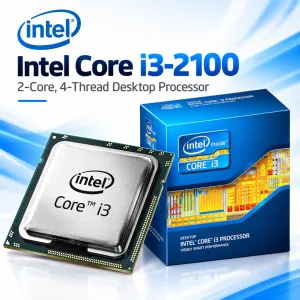
- 3.20 GHz Dual-Core Clock Speed for Reliable Everyday Computing
- Intel Hyper-Threading Technology Enabling 4 Parallel Threads
- Built-in Intel HD Graphics for Integrated Display Support
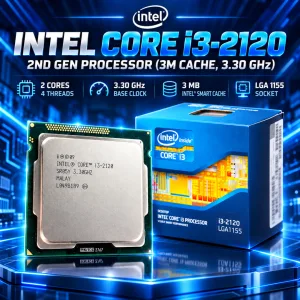
- 2 cores and 4 threads with Intel Hyper-Threading Technology
- 3.10 GHz base processor frequency
- 3 MB Intel Smart Cache
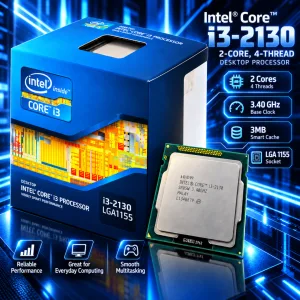
- 2 Cores and 4 Threads with Intel Hyper-Threading Technology
- 3.30 GHz Base Clock Frequency with 3 MB Intel Smart Cache
- Includes Intel HD Graphics 2000 integrated graphics
- 2 cores and 4 threads with Intel Hyper-Threading Technology
- 3.40 GHz processor base frequency with 3 MB Intel Smart Cache
- Integrated Intel HD Graphics 2000
Compare i3-5010U with Similar Processor
Real-world benchmark differences, TDP energy consumption, pros & cons, and market pricing in Bangladesh.